Office-to-Residential Conversions: Could They Change Urban Housing?

12 Oct 2026
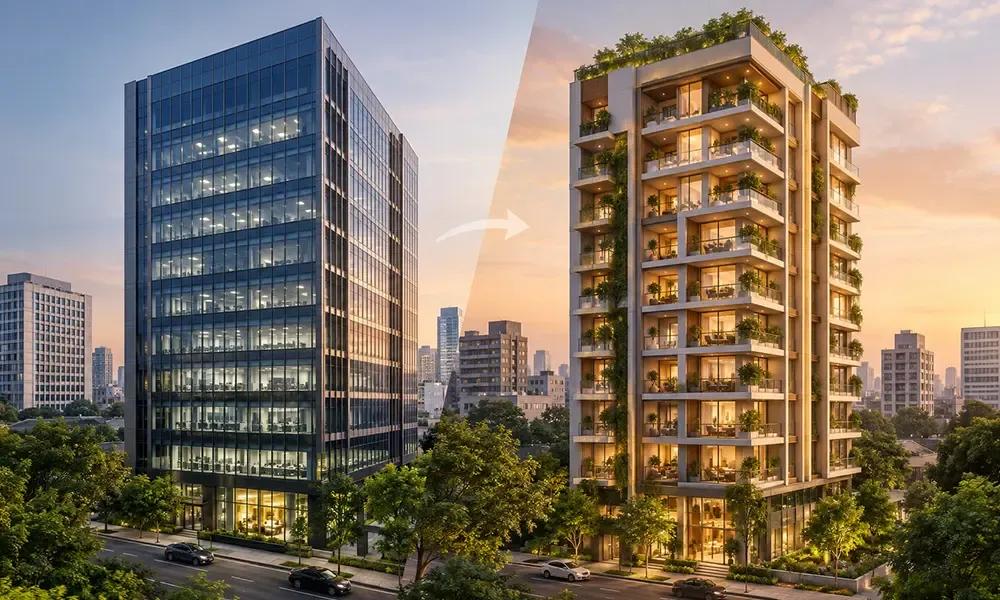
Cities are always changing. Areas that once worked as business districts may later need more homes. Buildings that were once full of office workers may become underused as companies shift to hybrid work, flexible seating, or newer office campuses. At the same time, many cities face a shortage of well-located housing close to jobs, transport, schools, hospitals, and daily conveniences.
This is where office-to-residential conversions become an interesting idea. Instead of demolishing an old or underused office building, the structure can be adapted into homes. Floors once planned for desks, meeting rooms, and cabins can be redesigned into apartments, co-living units, serviced residences, student housing, or rental homes.
The idea sounds simple: if offices are empty and cities need homes, why not turn offices into housing? But the reality is more complex. Not every office building can become a good residential building. Design, light, ventilation, plumbing, fire safety, parking, regulations, cost, and market demand all decide whether a conversion makes sense. Still, when done well, office-to-residential conversions can help cities use existing land better and bring more life back into urban areas.
What Are Office-To-Residential Conversions?
Office-to-residential conversion is a form of adaptive reuse. It means an existing office building is repurposed for residential use instead of being used as a commercial workspace.
This can take different forms. A building may be converted into standard apartments. Some may become co-living spaces or rental housing. Others may become student accommodation, senior living, or serviced apartments. The final format depends on the building design, location, demand, regulations, and financial feasibility.
The main idea is to reuse the structure instead of starting from scratch. This can save time, reduce construction waste, and make better use of already developed urban land.
However, conversion is not just an interior design exercise. It often requires deep structural, mechanical, electrical, plumbing, fire-safety, and legal changes. A building designed for office work has very different needs from one designed for homes.
Why This Idea Is Gaining Attention
Office-to-residential conversions are gaining attention because many cities are dealing with two problems at the same time. First, some office buildings are underused, especially older buildings in central business districts. Second, housing in well-connected urban areas is expensive and limited.
Hybrid work has changed office demand in several global markets. Some companies need less space than before. Others prefer newer buildings with better amenities, sustainability features, and flexible layouts. This can leave older office buildings struggling to attract tenants.
At the same time, people still want to live near transport, jobs, schools, healthcare, and lifestyle infrastructure. Converting suitable offices into homes can place more residents in central and well-connected areas without expanding the city outward.
This makes the idea attractive to planners, developers, investors, and governments looking for ways to revive urban districts.
How Conversions Can Help Urban Housing
Office-to-residential conversions can add housing in places where new land is difficult to find. In dense city centres, large vacant plots are rare. Redevelopment can be expensive and slow. Adaptive reuse offers another route.
When older offices are converted into homes, cities can create new residential supply without pushing every new project to the outskirts. This can reduce pressure on suburban expansion and make better use of existing roads, utilities, public transport, and social infrastructure.
Conversions can also bring people back into areas that become quiet after office hours. Many business districts are active during the day but empty in the evening. Adding residents can make these areas livelier, improve safety, support restaurants and shops, and create a more balanced neighbourhood.
In this sense, conversions are not only about housing supply. They can also change how a district functions.
The Sustainability Advantage
One of the strongest arguments for office-to-residential conversion is sustainability. Reusing an existing building can reduce the need for full demolition and new construction. This can help lower construction waste and preserve the embodied carbon already invested in the structure.
Buildings carry environmental value through the materials, labour, and energy already used to create them. When a city demolishes a usable building, much of that value is lost. Conversion allows the city to extract more life from the existing asset.
This does not mean every old office should be saved. Some buildings may be unsafe, inefficient, or too difficult to convert. But when the structure is suitable, adaptive reuse can be a more responsible approach than starting over.
For cities trying to balance growth with sustainability, this can be a meaningful advantage.
Why Not Every Office Can Become a Home
The biggest challenge is building design. Offices and homes are planned differently.
Many office buildings have deep floor plates. This means the distance from the windows to the centre of the floor is large. In an office, this may work because artificial lighting and open workstations can fill the space. In a home, it becomes harder because bedrooms and living areas need natural light, ventilation, and usable window access.
Plumbing is another challenge. Offices usually have shared washrooms in central locations. Homes need kitchens, bathrooms, utility areas, drainage lines, and water supply across many units. Adding this infrastructure can be expensive and technically difficult.
Fire safety, exits, elevators, parking, ceiling heights, shafts, balconies, and sound insulation also need careful study. A building that looks empty and available may still be unsuitable for residential conversion.
This is why conversion feasibility must be studied building by building.
The Cost Question
Office conversion is not always affordable than new construction. In some cases, it can be expensive because developers must work within the limits of an existing structure.
They may need to cut new shafts, upgrade services, strengthen parts of the building, change façades, add windows, redesign cores, improve fire safety, and modify parking. These changes can raise costs quickly.
If the final homes become too expensive, the project may not solve the housing problem. It may simply become another premium development. For conversions to help urban housing meaningfully, the numbers must work for both developers and buyers or renters.
This is where policy support can matter. Tax incentives, faster approvals, zoning flexibility, reduced parking requirements, or adaptive reuse guidelines can make conversions more feasible.
The Role of Regulations
Land-use rules are one of the biggest barriers. A building approved for commercial use may not automatically be allowed to become residential. Zoning, building codes, fire norms, parking rules, environmental approvals, and municipal permissions may all need to be revisited.
In India, this can be especially complex because urban land-use rules can be strict and fragmented. A conversion may require approvals from multiple departments, depending on the city and property type.
Clear policy is essential. Cities need to define where conversions are allowed, what safety standards apply, how parking will be handled, how infrastructure impact will be assessed, and whether mixed-use models are acceptable.
Without clear rules, conversion projects can become slow, uncertain, and risky.
Could This Work in Indian Cities?
Office-to-residential conversions could work in Indian cities, but selectively. They are more likely to succeed in locations where there is underused commercial stock, strong housing demand, good transport access, and supportive planning rules.
Cities like Bengaluru, Mumbai, Delhi-NCR, Pune, Chennai, Hyderabad, and Kolkata all have older commercial pockets where some buildings may become less competitive over time. However, not every office district has large vacancy or suitable buildings. Many Indian commercial markets still have strong demand in prime areas.
The opportunity may be strongest in older, mid-sized commercial buildings that are well-located but no longer attractive as modern offices. Such buildings may be better suited for rental housing, serviced apartments, co-living, student accommodation, or smaller urban homes.
For India, the model may not be a mass solution immediately. It may begin as a niche but useful redevelopment tool.
What It Means for Developers
For developers, office-to-residential conversion offers both opportunity and risk. The opportunity lies in acquiring or partnering on underused assets in strong locations. Instead of competing for scarce residential land, developers can unlock value from buildings that already exist.
The risk lies in feasibility. A poorly chosen building can become a financial trap. Structural limitations, approval delays, cost overruns, and weak residential demand can reduce profitability.
Developers need strong technical teams to study floor plates, services, compliance, market demand, and pricing. They also need to choose the right residential format. A deep office floor plate may not work for luxury apartments, but it may work better for co-living if designed carefully.
The success of a conversion depends on matching the building to the right housing product.
What It Means for Homebuyers
For buyers, converted office buildings can offer homes in central, well-connected locations. This can be attractive if the project is thoughtfully designed and legally clear.
However, buyers must ask the right questions. Was the change of use approved? Are fire safety norms compliant? Is there enough natural light and ventilation? Are plumbing and electrical systems properly redesigned? Is sound insulation adequate? Is parking sufficient? Are balconies available or absent? Is the building’s age reflected in pricing?
A converted home should not feel like an office with bedrooms added. It should function like a proper residence.
Buyers should also check maintenance costs. Older structures may require higher upkeep if services are not upgraded well.
What It Means for Cities
For cities, conversions can support more balanced urban growth. They can bring housing closer to jobs, reduce pressure on the urban edge, and revive business districts that have become less active.
They can also support the idea of mixed-use neighbourhoods. A district with homes, offices, shops, cafés, schools, and public transport can remain active throughout the day, instead of becoming empty after business hours.
However, cities must plan carefully. Adding residents to a commercial district requires schools, healthcare, parks, grocery stores, waste management, water supply, public transport, and pedestrian infrastructure. Housing cannot be inserted into an area without supporting daily life.
Urban housing is not only about units. It is about neighbourhoods.
The Best Use Cases
Office-to-residential conversions work best when certain conditions come together. The building should have good window access, manageable floor depth, structural strength, clear ownership, and services that can be upgraded. The location should have strong residential demand, transport access, and daily conveniences nearby.
The project should also have a realistic housing format. In some cases, compact apartments may work. In others, rental homes, co-living, student housing, or senior living may make more sense.
The best conversions are not forced. They respect the building’s limitations and design around them.
The Limitations
Office-to-residential conversions will not solve the housing crisis alone. The number of suitable buildings is limited. Costs can be high. Approvals can be slow. Some converted homes may end up being premium products rather than affordable housing.
There is also the risk of overhyping the idea. A city cannot assume every empty office tower is a future apartment building. Many will remain better suited for commercial, hospitality, education, healthcare, or mixed-use purposes.
Conversions should be seen as one tool among many. Cities still need new housing supply, rental housing policies, transit-oriented development, better land-use planning, and infrastructure investment.
Conclusion
Office-to-residential conversions could change urban housing, but not by replacing traditional development. Their real value lies in selective, intelligent reuse. When the right building, location, policy, and market demand come together, conversions can create new homes, revive urban districts, reduce waste, and make better use of existing infrastructure.
For Indian cities, the idea is especially interesting because many urban areas need more well-located housing. However, the model will work only if building codes, approvals, design quality, and financial feasibility are handled carefully.
The future of urban housing may not be only about building outward. It may also be about looking inward at the buildings cities already have, and asking whether they can serve a new purpose.
Office-to-residential conversions may not be the complete answer, but they can be an important part of a smarter, more flexible urban future.

