The Evolution of Modern Living: From Traditional Homes to Smart Apartments

27 Nov 2026
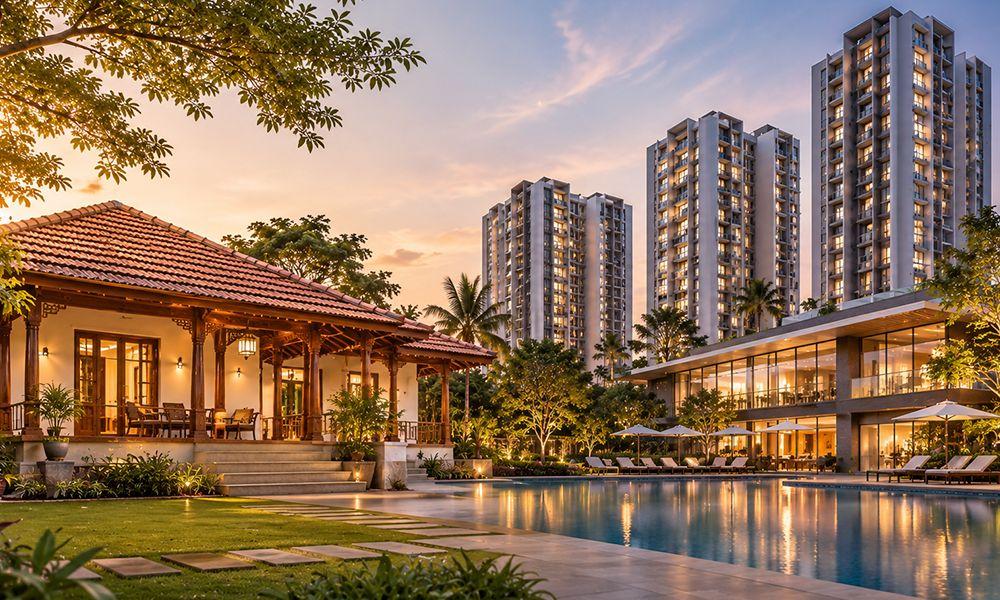
Most of us can picture a house from childhood, our own or a grandparent's. It probably had a wide veranda where the elders sat out the afternoon, a courtyard that pulled sunlight into the middle of the house, and a kitchen that never seemed to close. You knew the neighbours by name. Children stayed out until someone called them in, and nobody booked a hall for a family function because the house was the hall.
Compare that with a new apartment in Bengaluru, Kochi or Pune. The front door opens with a code. The lights respond to a phone. Downstairs there's a pool, a gym, a co-working room, and an app that tells you a visitor is at the gate. It's a home built for a routine our grandparents would have found hard to picture.
How we got from one to the other says a lot about how India has changed. Families shrank, cities spread outwards, work routines shifted, and technology crept into ordinary life. What people want from a home, though, has barely moved: comfort, safety, some privacy, less hassle, and room for the people they love.
Traditional Indian Homes Were Built Around Family Life
Older Indian homes were shaped by two things: the family living inside and the weather outside.
Keralam's courtyard houses had sloping roofs and deep, shaded verandas, which made sense in a place with that much heat and rain. In parts of North India, the house wrapped around an aangan, and that open square was where the family sat together, where children played and where half the household chores got done. Old Bengaluru neighbourhoods were known for big windows, verandas and gardens. In Kolkata, you'd find high ceilings, long corridors and balconies that looked down on the street.
None of this was decoration for its own sake. These features kept the house comfortable and gave a large family room to get through the day.
The house was a social place too. Festivals, family occasions, a neighbour dropping in for a chat, relatives who came to stay: all of it happened at home. Rooms were shared as a matter of course, and privacy meant something quite different from what it means now.
Urbanisation Changed the Way Indians Lived
That model became harder to sustain once cities started growing quickly. Land in established areas got expensive. Jobs drew people in from smaller towns, and more of them set up households of their own.
Apartments were the practical answer. A developer could house many families on a plot that would once have held a single home, which put more people within reach of offices, schools, hospitals and markets. For many middle-class families, a flat was also the realistic route to owning property in a city where buying land and building on it had become too expensive.
It didn't happen overnight, and independent houses and old residential colonies are still around. But over the years, living in a flat became normal in India's growing cities.
From Joint Families to Smaller Households
Family structure changed alongside the skyline, and house design followed.
A traditional home often held several generations, which explains the big kitchens, common sitting areas, spare bedrooms and open space outside. Once work began pulling people to other cities, nuclear families and smaller households became far more common.
A young couple who move to Bengaluru for work will often take a 2 BHK near an IT corridor over an independent house much farther out. A small family in Kochi may care more about being close to a school and a hospital than about owning a large plot.
That isn't the same as family traditions fading. Ask apartment buyers today what they want and you'll still hear about a pooja space, a comfortable kitchen, an extra bedroom for when parents visit, and enough room to celebrate a festival properly. The address is new. The wish list is old.
Apartments Introduced a Different Kind of Convenience
Part of the appeal of a flat is that someone else handles the upkeep.
Own an independent house and almost everything is your problem: repairs, security, the exterior, general upkeep. In an apartment community, a residents' association or a facility management team takes on most of that. Security, lift servicing, cleaning of common areas, waste collection and landscaping are handled collectively.
If both partners get home late, the last thing they want is to chase someone about building maintenance.
There's a maintenance bill every month, though, and community rules you may not always agree with. Even so, managed upkeep is one of the main reasons urban families keep choosing apartments.
Gated Communities Changed Residential Expectations
Then came gated communities, and buyers stopped judging a project by the flat alone. What lay outside the front door started to matter just as much.
Pools, clubhouses, landscaped gardens, gyms, sports facilities and play areas turned into selling points, and projects began to be planned around them. A buyer could now pick a community where the children had a proper place to play, the adults could exercise without travelling, and a family gathering didn't mean leaving the premises.
There was a quieter benefit as well. People who had left their hometowns found that shared amenities were an easy way to meet neighbours and make friends. In a sense these complexes were rebuilding the social ties that old neighbourhoods produced without trying, only now inside an organised apartment complex.
The Home Became More Than a Place to Sleep
How people use their homes has shifted a lot in the last few years.
Plenty of professionals work from home for at least part of the week. Children take online classes or use digital learning platforms. Families stream films, exercise indoors and take up hobbies without stepping out.
Layouts have had to keep up. The spare bedroom doubles as an office. A balcony turns into a small garden or a reading corner. The dining table must cope with a laptop now and then.
Buyers have grown fussier. They ask about natural light, ventilation, storage and whether a room can serve more than one purpose. A flat that looks lovely on a short site visit can feel very different once several people are working, studying and relaxing in it at once.
Smart Technology Entered the Indian Home
The change you notice first in a new apartment is the technology. Features that sounded futuristic not long ago are turning up more and more in premium projects.
Lights can be run from a mobile app. Digital locks give you other ways to get in. A video door phone shows you who's outside before you open up. Some homes add automated curtains, connected appliances, climate control and systems that track energy use.
Picture getting home after a long day and setting the lights and the AC without walking from room to room. Some buyers love that; others care more about the security side, or about being able to check on things at home while travelling.
Not every new apartment comes with these features. What you get depends on the developer, the project segment and the specifications on offer.
Security Has Become More Technology-Driven
Old neighbourhoods were kept safe by familiarity. Everyone knew who belonged on the street, and a stranger got noticed.
A large apartment complex can't work that way, so security has become more structured. Communities now use visitor management systems, access control, CCTV and digital communication tools to handle who comes in. You might get a phone alert when a guest arrives or message the security desk through an app. Families with children, senior citizens and frequent travellers find this particularly useful.
These systems only work well, however, when trained guards and clear procedures back them up. A visitor app can't stand in for responsible building management or proper emergency preparedness.
Energy Efficiency Is Becoming Part of Home Design
Technology is changing how homes use electricity and water as well.
Efficient lighting, smart meters, solar installations and automated controls help residents see what they consume and manage it. Some developments add rainwater harvesting, wastewater treatment and water-saving fixtures. As households keep a closer eye on utility bills and environmental impact, these features carry more weight.
Traditional Indian architecture has something to teach here. Older homes stayed comfortable through natural ventilation, shaded openings, courtyards and materials suited to the local climate. Many modern apartments lean heavily on artificial cooling instead.
The sensible approach borrows from both: sound natural design first, then the right technology on top. A well-ventilated flat with efficient appliances will often be nicer to live in than a technologically advanced one that gets little light or air.
Community Living Is Being Reimagined
As homes get smarter, buyers are rediscovering how much community matters.
Traditional neighbourhoods encouraged unplanned contact. People chatted at their doorsteps, children played together, and a festival could bring a whole street out. Apartment communities try to create the same openings through clubhouses, community halls, walking tracks and gardens.
Many also organise Diwali celebrations, sports activities, cultural programmes and events for children. For someone new to a city with no extended family nearby, these can mean a great deal. Technology makes a home convenient. It's the people who make a neighbourhood feel welcoming.
Why Location Still Matters in a Smart Apartment
A smart apartment can be full of excellent features and still be awkward to live in. Automated lighting and digital security won't help much if the approach road is poor or the nearest hospital is a long way off.
So, location still drives the decision. Buyers weigh up access to work, schools, healthcare, public transport, shopping and everyday services. In Bengaluru, someone employed along Outer Ring Road will probably put a manageable commute first. A family in Kochi may look harder at schools, healthcare and links to established neighbourhoods.
Smart features improve life inside the flat. The surrounding infrastructure decides how smoothly the household runs outside it. A buyer has to look at both.
Are Smart Apartments Always Better Than Traditional Homes?
Not necessarily.
Traditional homes have strengths that apartments struggle to match, especially independent outdoor space, freedom over design and direct control of the property. They're also easier to extend or alter, subject to regulations. Apartments counter with managed security, shared facilities and access to urban conveniences.
Smart technology brings one more thing to think about, which is maintenance. Connected devices need reliable internet, software updates, technical support and, sooner or later, replacement. A buyer should find out whether the systems can be operated manually, whether the devices work together, and what happens if a service provider stops supporting them.
Technology ought to make owning a home simpler. If it leaves you dependent on complicated systems, it has missed the point. The better home is whichever one fits what your household really needs.
What the Next Generation of Homes Could Look Like
The next phase of housing may have less to do with adding devices and more to do with adaptability.
Buyers are likely to value layouts that can handle working from home, a growing family, ageing parents and changing technology. Developers may pay closer attention to energy efficiency, accessible design, EV charging provisions, water management and dependable community infrastructure. Smart home systems may also get simpler to use.
Even then, good housing will rest on the basics: natural light, ventilation, comfortably proportioned rooms, privacy, safe common areas and reliable maintenance. A future-ready home can absorb changes in how people live without becoming complicated to run.
Conclusion
The move from traditional Indian homes to smart apartments mirrors a wider change in how people live, work and relate to the places around them.
Traditional houses prized family interaction, climate-responsive design and shared space. Apartments brought convenience, organised upkeep and access to growing cities. Smart technology has added automation, better security and connected services. Each stage contributed something worth keeping.
Today's homebuyers don't have to pick between traditional warmth and modern convenience, because a well-designed apartment can offer both: the security and amenities of contemporary living, along with the light, the air, the family spaces and the sense of belonging that made older Indian homes special.
Technology will keep changing how a home works. What makes it feel like home hasn't changed much at all.

